The Video Deficit Phenomenon: Why Young Kids Learn Less From Videos
Screen Time & Child Development (Singapore)
The Video Deficit Phenomenon: Why Young Kids Often Learn Less From Videos
Quick definition: The video deficit phenomenon describes a common finding in child development research: babies and toddlers usually learn less from screens than from live, in-person interaction.
This guide explains what it means for ages 0–12, and how parents can make screen use more learning-friendly without panic or guilt.
What the video deficit is
Parents often hope “educational videos” will teach language, manners, or problem-solving. Research shows that for infants and young toddlers, learning from video is often weaker than learning from a real person doing the same teaching. That gap is called the video deficit effect (sometimes described as the video deficit phenomenon).
Important: This does not mean all screens are “bad.” It means that for very young children, screens are usually a less efficient teacher than real-life interaction—especially for language and transfer of learning to the real world.
Why it happens (simple science)
1) “2D-to-3D transfer” is hard for little kids
Videos are flat (2D). Real life is 3D. For infants and young toddlers, it can be difficult to take what they see on a screen and apply it to objects in real life.
2) Social interaction is a powerful learning engine
Babies learn best when a caregiver responds to them—eye contact, turn-taking, joint attention (“Look at the dog!”), and feedback. Passive videos don’t respond to your child, so the learning signal is weaker.
3) Attention gets pulled by “entertaining” features
Fast cuts, music, bright visuals, and constant motion can hold attention without deep understanding. A child may look engaged but still learn little—especially under age 2.
4) Real learning needs practice and memory cues
Skills stick when kids do something: touching, trying, repeating, applying it to daily life. If video time replaces hands-on play, talk, or shared reading, learning opportunities shrink.
What it looks like by age (0–12)
Ages 0–18 months
- Most learning should come from people: talk, sing, face-to-face play, peekaboo, reading.
- Passive video is least effective here. If screens are used, video chat with real interaction is typically more meaningful than pre-recorded video.
Ages 18 months–2 years
- Toddlers may imitate simple actions from screens, but learning is still often weaker than live demonstration.
- If you use videos, watch together and connect it to real life immediately (e.g., watch “brush teeth” then go brush teeth).
Ages 2–5 years
- Children can learn more from well-designed content—especially with co-viewing, pausing, and discussion.
- They still benefit from hands-on practice right after the video (crafts, pretend play, real-world tasks).
Ages 6–12 years
- Primary-school kids can learn academic content from videos, but they learn best when they are active (taking notes, answering questions, doing practice).
- For habits/values (empathy, manners, self-control), real-life modeling and conversations still beat passive viewing.
How to reduce the deficit: parent strategies that work
1) Co-view and “coach” (especially under 6)
- Sit with your child (even 5–10 minutes helps).
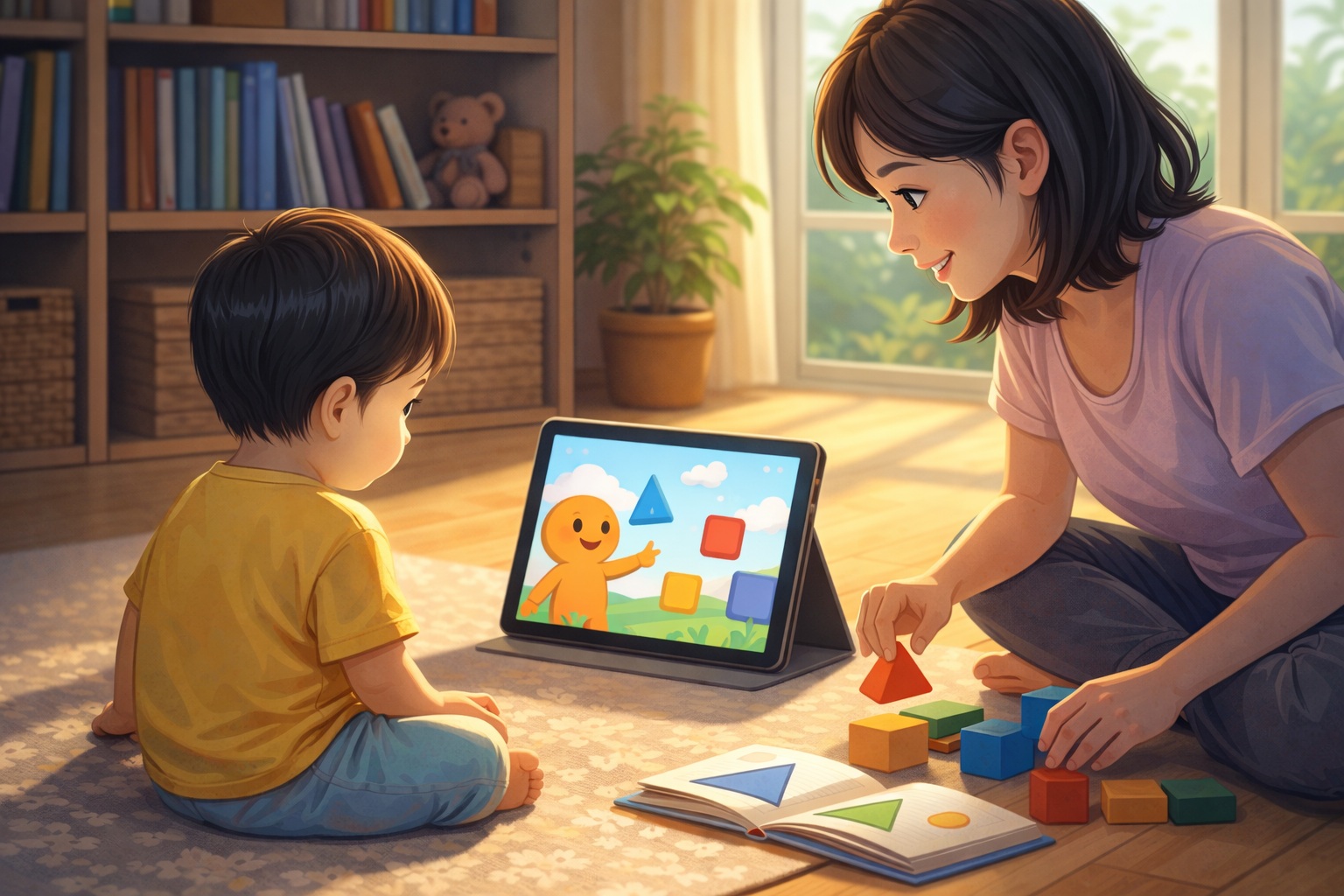
- Name what’s happening: “That’s a triangle. Can you find one at home?”
- Ask simple questions: “What do you think happens next?”
2) Pause + apply (turn video into real-life practice)
- After a video about animals, go to a picture book and point to the animals.
- After a “counting” clip, count real objects (grapes, blocks, toys).
- After a “feelings” story, ask: “When did you feel like that today?”
3) Choose slower, age-appropriate content
Look for content that uses clear language, repetition, and simple storylines. Avoid very fast-paced videos for young kids—“captivating” doesn’t always mean “teaching.”
4) Prefer interaction over passive viewing (for the youngest)
- Best: live play + talking + reading.
- Better than passive: video chat with a responsive adult.
- Hardest for learning: pre-recorded videos watched alone.
5) Protect routines: meals and bedtime
Screens during meals and close to bedtime can disrupt routines and crowd out conversation and sleep. Make “device-free meals” and “screens-off before bed” a family norm.
Singapore guidance (practical reminders)
- Under 18 months: Singapore guidance discourages screen exposure, except for interactive video chatting.
- 18 months–6 years: Keep recreational screen time under 1 hour/day (outside of school), avoid using screens to distract, and avoid screens during meals and one hour before bedtime.
- 7–12 years: Many local summaries of MOH guidance recommend keeping recreational screen time under 2 hours/day (outside school), with healthy habits and boundaries.
FAQ
What is the video deficit phenomenon?
It’s the research finding that infants and young toddlers often learn less from screens than from live teaching. The same lesson delivered face-to-face typically produces stronger learning than a video version.
Does this mean “educational videos” don’t work?
Not exactly. Learning from video usually improves with age, and it improves a lot when parents co-view, discuss, and help children apply the content to real life—especially from around age 2 onwards.
What about video calls with grandparents?
Video chat can reduce the deficit because it includes real-time responsiveness (two-way conversation, turn-taking, joint attention). It’s generally more developmentally meaningful than passive viewing for very young children.
My child watches a lot but “knows” the words—does that count as learning?
Kids can memorize songs or labels from videos, but deep learning is shown when they can use the skill in real life (e.g., using a word correctly in conversation, counting objects accurately, applying a safety rule). Co-view + practice helps bridge that gap.
How can I tell if screen time is replacing real learning?
Watch for reduced pretend play, less shared reading, fewer back-and-forth conversations, and more resistance at transitions (meals, bath, bedtime). A simple fix is to shorten video time and add one “real-world practice” activity afterwards.
It takes a village to raise a child !
Join our Facebook group Preschools & Kindergartens in Hong Kong to interact with other parents.