Reflective Parenting and Positive Discipline: Raising Emotionally Aware and Resilient Kids
Introduction
In a world that often prioritizes academic performance and external behavior, many parents are shifting focus to something deeper: their child’s emotional world. Reflective parenting and positive discipline are two complementary approaches that nurture a child’s inner development while guiding behavior with empathy and consistency. Grounded in neuroscience, attachment theory, and child psychology, these methods are gaining traction for raising confident, emotionally intelligent children.
What Is Reflective Parenting?
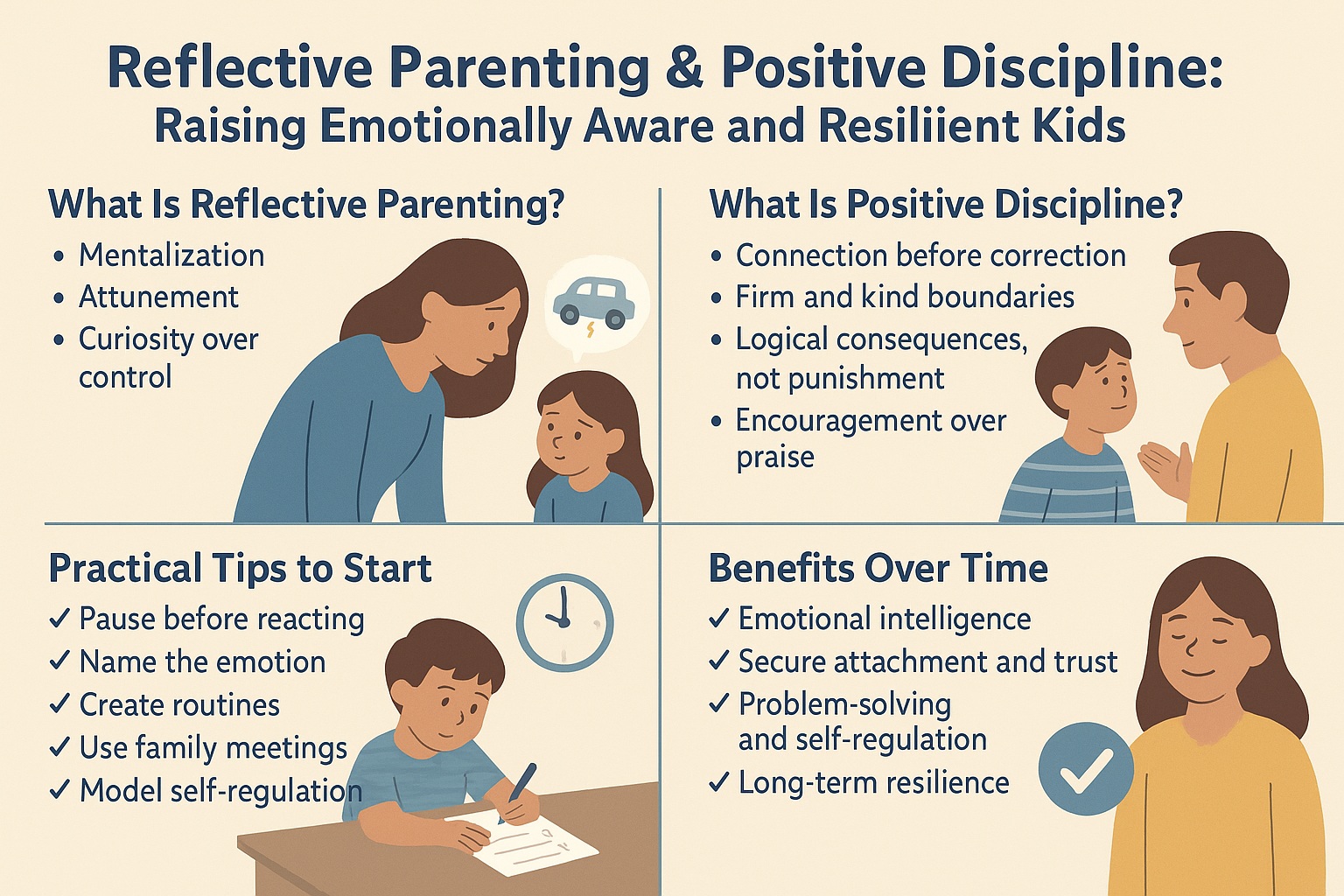
Reflective parenting is a mindful approach where parents strive to understand the thoughts, feelings, and needs behind a child’s behavior. Instead of reacting impulsively, they pause to reflect on what might be driving their child’s actions.
Key Elements:
- Mentalization: Understanding your child’s internal experience—what they might be thinking or feeling.
- Attunement: Staying emotionally connected, especially during difficult moments.
- Curiosity over control: Asking, “What is this behavior telling me?”
Example:
When a child throws a tantrum over a broken toy, a reflective parent might think, “Are they really upset about the toy, or is something else going on—like feeling unheard or tired?”
What Is Positive Discipline?
Positive discipline focuses on teaching, not punishing. It emphasizes mutual respect, clear expectations, and long-term skill building. Developed by experts like Dr. Jane Nelsen, it encourages self-discipline, problem-solving, and empathy.
Core Principles:
- Connection before correction
- Firm and kind boundaries
- Logical consequences, not punishment
- Encouragement over praise
Example:
Instead of yelling at a child for forgetting homework, a positive discipline approach might involve helping them create a checklist and reflect on how it felt to be unprepared.
The Brain Science Behind These Approaches
- Emotional safety supports brain development and helps children regulate behavior.
- Serve and return interactions help build resilience and empathy.
- Harsh discipline may trigger stress responses that impair learning and emotion regulation.
How They Work Together
Reflective parenting helps you see the “why” behind the behavior; positive discipline helps you respond with the “how.” Together, they shift discipline from being reactionary to relational.
Scenario:
Your child hits a sibling out of frustration.
Reflective response: “What need was my child trying to meet?”
Positive discipline: “Let’s talk about other ways to handle frustration. You can walk away or ask for help.”
Practical Tips to Start
- Pause before reacting – Give yourself a breath to reflect first.
- Name the emotion – Help your child label feelings: “You look disappointed.”
- Create routines – Predictability fosters cooperation.
- Use family meetings – Teach problem-solving collaboratively.
- Model self-regulation – Children learn from how we manage our emotions.
Benefits Over Time
Reflective parenting and positive discipline build:
- Emotional intelligence
- Secure attachment and trust
- Problem-solving and self-regulation
- Long-term resilience
Final Thoughts
In today’s performance-driven culture, choosing to slow down and reflect may feel counterintuitive—but it’s what children need most. By blending reflective parenting with positive discipline, we nurture not just good behavior, but capable, emotionally aware human beings.
FAQ: Reflective Parenting & Positive Discipline
1. Is positive discipline the same as permissive parenting?
No. Positive discipline sets clear and consistent boundaries while maintaining empathy and connection. Permissive parenting lacks structure, while positive discipline teaches responsibility through guidance.
2. How can I be a reflective parent when I’m stressed or tired?
It starts with pausing. Even a few seconds to breathe and ask yourself “What is my child feeling?” can shift your reaction. Self-care also plays a big role in your ability to stay reflective.
3. What if my child keeps repeating the same bad behavior?
Repetition is normal. Reflective parenting helps you stay consistent in your response. Use logical consequences, talk through feelings, and help them build new coping tools.
4. Can teachers use these strategies in the classroom?
Yes. Many educators now use positive discipline and social-emotional learning (SEL) to create safe, respectful classroom environments where children feel heard and supported.
It takes a village to raise a child !
Join our Facebook group Preschools & Kindergartens in Hong Kong to interact with other parents.