Fostering Creativity: Valuing Process Over Product
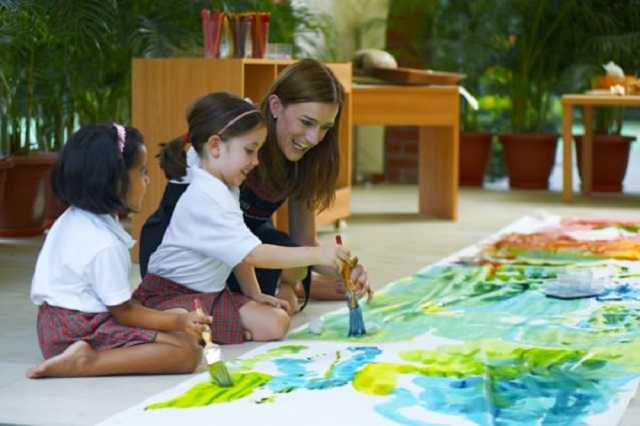
Observing a child experimenting with art materials slows down time. Children enjoy the physical sensation of paint dragging across the canvas or squishing clay with their fingers. Is there value in these activities? What does it have to do with creativity? What if the end result adds up to a pile of clay scraps or a mound of brown paint? Is it art? Are these activities valuable, even if they do not turn into a polished ‘finished’ product? Parents and teachers might find it hard to suspend the idea that a ‘finished’ product is proof of ‘successful’ learning. Yes, it is fun to have a shiny art piece to show and there is a sense of accomplishment; of a job well done. But is it possible that we have gone too far and have forgotten about why we create art in the first place?
Considering a young child from a developmental perspective, might we expect too much ‘product’ too soon and simultaneously expect too little ‘process’ at all ages? Exactly how does a caring parent or well-meaning teacher foster creativity and experimentation within a child?
Accepting failure. When a child handles paint and it drips, the child learns to tolerate frustration and persevere. He may not see it as a “poor” result but rather an opportunity to learn. He may even like the dripping effect and repeat it deliberately. If the teacher’s response is one of negative affect, the child certainly will learn that some paintings are better than others, and they will begin to judge their own work, potentially hindering their creative expression.
Accept children’s efforts at art as valuable no matter the aesthetics of the outcome. Children are eager to experiment and to figure out how things work, we need only get out of their way. As adults, we can intentionally recognize this natural curiosity as an opportunity to cultivate positive learning experiences. Providing children the time and opportunity to experiment gives them permission to relax and learn without pressure. If we are too focused on a final product, it takes away from their experience and limits their learning.
Allow unstructured play. When children determine for themselves the course of their interest, they engage in sustained play. What unanticipated discoveries might arise from children taking the lead in their own play? We can prepare an environment with a variety of stimuli as an invitation, leaving the “what” and “how” up to the child. Adopting an attitude of open-ended exploration allows children to use materials freely, often in ways that the adults may not be able to predict or prepare for even if they tried. It is a state of exploration that can only be achieved through open-ended play environments. Because young children hold no preconceptions about the capabilities of various materials, they are more apt to experiment. Children are capable learners and sometimes it is as simple as providing the time and space for children to ride the waves of their natural intelligences.
'Creativity is the ability to challenge, question and explore. It involves taking risks, playing with ideas, keeping an open mind and making connections where none are obvious.'
- Victoria and Albert Museum of Childhood
When children are given unstructured time to explore and test out theories, they are discovering the world around them. Children learn by doing. Creativity does not have to be limited to painting a nice picture. Whoever decided what ‘nice’ is anyway? Labeling children’s art as ‘good’ or ‘bad’ is counter to free expression and imposes limits instead of being open to possiblities.
Creativity blossoms in an environment free of fear or coercion. It will not be hurried; it does not need to be. The finished product is secondary to the experimentation and experience of the child. Creativity encompasses a way of thinking and being in the world that doesn’t need proof to exist, only the joy of the experience gained.
It takes a village to raise a child !
Join our Facebook group Preschools & Kindergartens in Hong Kong to interact with other parents.